
Business Assignment Help
Business assignments require students to apply business concepts, analyse real-world organisations and develop evidence-based arguments. At Easy Assignment Help, we provide Business Assignment Help for UK university and college students, offering guidance with assessment briefs, coursework planning, research, case studies, management reports and strategic analysis. Our support helps you strengthen your subject knowledge, improve your academic writing and approach assignments with confidence while ensuring your work remains your own and meets your university's academic integrity requirements.
Discuss Your Business Assignment
Business Assignment Help UK for University and College Students
Business courses cover a wide range of disciplines, and their assessments can involve different research methods, theoretical frameworks and practical applications. Our academic support is designed to help students understand these requirements and approach their coursework in a structured way.
Students studying at UK universities and colleges may need to analyse company performance, examine organisational behaviour, evaluate marketing strategies or investigate changes in the business environment. Each task requires a clear understanding of the question and the ability to connect academic concepts with relevant evidence.
Our support can help you with:
- Understanding assignment questions and assessment briefs.
- Identifying relevant business theories and concepts.
- Planning a logical assignment structure.
- Finding suitable academic and industry sources.
- Developing critical analysis and evidence-based arguments.
- Applying business frameworks to organisational situations.
- Improving referencing, presentation and academic writing.
Get a Free Quote
Send your brief and we will reply on WhatsApp or email.
Business Assignment Support for Different Academic Levels
The depth of analysis and academic expectations change as students progress through their education. We tailor our guidance to the level and requirements of your course.
College and BTEC Business Assignments
College-level business assessments often introduce students to marketing principles, business operations, finance, organisational structures and enterprise. We can help you understand assessment criteria, organise your research and explain business concepts through relevant examples.
Undergraduate Business Assignments
Undergraduate assignments require students to move beyond describing business concepts. You may need to compare management theories, evaluate organisational decisions and support your arguments with academic evidence. Our guidance can help you develop these skills across different modules.
Postgraduate and Master's Business Assignments
Postgraduate assessments generally demand deeper critical evaluation, independent research and stronger theoretical application. We can help you understand complex concepts, assess research evidence and develop a coherent approach to advanced business topics.
MBA Assignment Guidance
MBA coursework often involves strategic decision-making, leadership, organisational change and practical business problems. We can provide guidance on selecting suitable frameworks, evaluating management decisions and connecting theoretical knowledge with professional scenarios.
Why Do Students Need Help with Business Assignments?
Students often seek academic support because business assignments involve several interconnected skills. Understanding a theory is one challenge, but applying it correctly, evaluating evidence and presenting a convincing argument can be equally demanding.
Here are some common difficulties students experience.
Understanding Complex Business Concepts and Theories
Business modules introduce concepts from management, economics, marketing, finance and organisational studies. Some theories may appear similar, making it difficult to understand their differences or identify the most appropriate approach for a particular question.
For example, students studying leadership may need to compare transformational and transactional leadership. Those studying strategic management may need to distinguish between competitive positioning and organisational capabilities.
We can help clarify these concepts and explain how they relate to the assignment question.
Applying Management Models to Real-World Organisations
Business assignments frequently ask students to examine real companies and assess their decisions. Knowing a framework is not enough. You must understand how to apply it to the organisation being studied.
For example, a SWOT analysis should identify relevant internal strengths and weaknesses alongside external opportunities and threats. A PESTLE analysis should examine the political, economic, social, technological, legal and environmental factors affecting the business.
Our guidance can help you select suitable frameworks, interpret findings and connect your analysis with the organisation's circumstances.
Conducting Business Research and Interpreting Data
Business research may involve financial information, market reports, customer surveys, academic studies and industry publications. Students must assess the reliability of these sources before using them to support their arguments.
We can guide you through primary and secondary research, qualitative and quantitative methods, source evaluation and basic data interpretation.
Developing Critical Analysis Instead of Descriptive Writing
One common challenge in university coursework is writing descriptively when the assessment expects critical analysis.
Descriptive writing explains what a concept means. Critical analysis examines why it matters, compares different viewpoints, evaluates supporting evidence and considers limitations.
For instance, rather than simply describing a company's marketing strategy, you might evaluate whether that strategy is suitable for its target market and whether the available evidence supports its effectiveness.
Managing Multiple Coursework Deadlines
Business students may have several assessments due within a short period. A report, presentation and case study can all require different research and preparation methods.
Assignment planning and prioritisation can help you break larger tasks into manageable stages, allocate research time and avoid leaving important sections until the last minute.
Following University Referencing and Assessment Requirements
Different universities and modules may specify particular referencing systems, formatting requirements and marking criteria. Incorrect citations, weak source selection or failure to address learning outcomes can affect the overall quality of your work.
We can help you understand these requirements and improve the presentation of your own academic work.
Our Business Assignment Writing Service and Academic Support
Our Business Assignment Writing Service is designed around academic guidance rather than replacing students' own work. We help you understand your requirements, develop an appropriate approach and improve the quality of your academic writing.
Depending on your needs, support may include the following.
Business Assignment Planning and Structuring
A clear structure helps readers follow your argument and understand how each section contributes to the assignment's objectives.
We can help you:
- Break down complex assignment questions.
- Identify the main issues that need addressing.
- Develop a suitable outline.
- Organise arguments into logical sections.
- Allocate appropriate space to each assessment requirement.
- Connect the introduction, main discussion and conclusion.
Business Assignment Research and Referencing Guidance
Strong business assignments depend on relevant and reliable evidence. We can explain how to identify suitable academic journals, textbooks, company reports and industry sources.
Our guidance covers source evaluation, literature searches, research questions, citation techniques and referencing conventions, including Harvard and APA styles where required.
Business Case Study Analysis Guidance
Business case studies ask students to investigate organisational situations and make evidence-based evaluations.
We can help you identify the central business problem, examine relevant stakeholders, assess possible explanations and apply appropriate management frameworks.
The aim is to develop your own ability to evaluate a situation rather than simply describe what happened.
Business Report Writing Help
Business reports often use a different structure from traditional academic essays. They may include an executive summary, introduction, methodology, findings, discussion, recommendations and references.
We can explain the purpose of each section and help you understand how to present findings clearly, use appropriate evidence and maintain a professional academic tone.
Business Assignment Editing and Proofreading
A well-researched assignment can still be difficult to follow if its language, structure or presentation is unclear.
Our editing and proofreading support can help identify:
- Grammar and spelling errors.
- Unclear or repetitive sentences.
- Weak paragraph transitions.
- Inconsistent terminology.
- Referencing and formatting issues.
- Problems with clarity and academic tone.
Editing should preserve your original ideas and authorship.
Business Assignment Feedback and Improvement
Feedback can help you identify areas that need further development before submitting your work.
We can review your draft against the assignment brief and discuss opportunities to improve argument development, evidence selection, critical evaluation and organisation.
One-to-One Business Assignment Consultation
Some students prefer to discuss their assessment requirements before beginning their work. A consultation can help clarify the task, identify relevant business concepts and establish a practical preparation plan.
You can share your assignment brief and explain the areas where you need additional academic guidance.
Business Subjects and Specialisations We Cover
Business education includes several interconnected disciplines, each focusing on a different aspect of how organisations operate, compete and grow. Understanding these specialisations helps students identify relevant theories, research areas and practical applications for their assessments.
Our subject coverage includes the following areas.

Business Management
Business management focuses on how organisations plan, coordinate and control their activities to achieve objectives. Students may examine organisational structures, leadership approaches, decision-making, resource allocation and performance management.
We can help you understand management concepts, evaluate organisational practices and connect theoretical models with practical business situations.
Marketing Management
Marketing assessments examine how organisations identify customers, develop products, position brands and compete in different markets.
Common topics include:
- Consumer behaviour and buying decisions.
- Market segmentation, targeting and positioning.
- Marketing mix and the 7Ps.
- Digital marketing strategies.
- Brand management and positioning.
- Marketing research and campaign evaluation.
Human Resource Management
Human Resource Management explores how organisations recruit, develop, motivate and retain employees. Assignments may involve workforce planning, employee engagement, performance management, training and development, equality and workplace relations.
We can explain relevant HR theories and help you evaluate how people management practices influence organisational performance.
Financial Management
Financial management involves examining how businesses manage their financial resources and make investment decisions.
Common assessment areas include financial planning, budgeting, cash flow management, investment appraisal, financial ratios, risk assessment and financial performance evaluation.
We can help you understand financial concepts, interpret financial information and explain the significance of your findings.
Strategic Management
Strategic management examines how organisations establish long-term objectives and respond to competitive pressures.
Students commonly study:
- Competitive advantage.
- Corporate and business-level strategies.
- Strategic planning and implementation.
- Industry and competitor analysis.
- Organisational capabilities.
- Strategic change and performance evaluation.
International Business
International business explores how organisations operate across national borders. Assignments may examine globalisation, international trade, foreign market entry, cultural differences and international business strategies.
We can help you assess international market conditions and understand the economic, political and cultural factors affecting multinational organisations.
Business Environment
The business environment covers internal and external factors that influence organisational activities. Students may examine economic conditions, government policies, technological developments, legal requirements and environmental responsibilities.
Frameworks such as PESTLE and SWOT can help organise this analysis.
Operations and Supply Chain Management
This specialisation examines how businesses manage production, distribution and the movement of goods and services.
Common topics include inventory management, procurement, logistics, quality control, supply chain risk, process improvement and operational efficiency.
Organisational Behaviour
Organisational behaviour focuses on how individuals and groups behave within workplaces.
Students may explore leadership, motivation, workplace culture, communication, teamwork, conflict management and organisational change.
Business Economics
Business economics applies economic principles to organisational decisions and market conditions.
Typical topics include supply and demand, market structures, pricing strategies, competition, inflation, economic growth and business forecasting.
Entrepreneurship and Business Development
Entrepreneurship examines how new business ideas are identified, developed and transformed into commercial opportunities.
Assignments may involve business model development, opportunity assessment, innovation, venture planning and growth strategies.
Business Analytics and Information Systems
Business analytics involves using data to support organisational decisions. Students may examine business intelligence, information systems, forecasting, data visualisation and performance measurement.
We can help explain analytical concepts and the role of data in business decision-making.
Project Management
Project management focuses on planning, organising and controlling resources to achieve defined objectives within agreed constraints.
Common topics include project scheduling, risk management, stakeholder engagement, resource allocation and project evaluation.
Business Ethics and Corporate Social Responsibility
This area explores the ethical responsibilities of organisations towards employees, customers, communities and the environment.
Students may examine corporate governance, sustainability, ethical leadership, stakeholder interests and corporate social responsibility.
Share your requirements and ask about available support.
Discuss Your Business AssignmentTypes of Business Assignments We Provide Academic Guidance With
Different assessments require different writing and analytical skills. Understanding the purpose and structure of each format can help you approach your coursework more effectively.
Business Case Studies and Company Analysis
A business case study examines a particular organisation, management decision or commercial challenge. Students must identify relevant issues, evaluate evidence and develop justified conclusions.
Company analysis may involve examining organisational performance, competitive positioning, leadership decisions and market conditions.
Business Management Essays
Business essays require a clear argument supported by academic literature and relevant examples. They often involve comparing theories, evaluating management practices and discussing different academic perspectives.
We can help you develop essay plans, organise supporting evidence and strengthen critical arguments.
Business Reports and Reflective Reports
Reports communicate research findings, organisational analysis and recommendations in a structured format.
Reflective reports have an additional focus on learning and personal development. They may require students to examine experiences, identify lessons and connect reflection with academic concepts.
Business Plans and Proposals
A business plan explains how a proposed venture or existing business intends to operate and develop.
Typical sections may include:
- Executive summary.
- Business objectives.
- Market research.
- Target customers.
- Marketing strategy.
- Operational planning.
- Financial forecasts.
- Risk assessment.
We can help you understand the purpose of each section and organise the information required.
Business Research Papers and Research Proposals
Research assessments require students to identify a problem, develop research questions and select appropriate methods.
Our guidance can cover literature searches, research objectives, methodology selection, data collection considerations and research ethics.
Business Presentations
Business presentations require students to communicate information clearly and logically. Common challenges include selecting relevant material, organising slides, presenting evidence and explaining recommendations.
We can help you develop a presentation structure and improve the clarity of your academic arguments.
Business Feasibility Studies
A feasibility study examines whether a proposed business idea, project or investment is practical and commercially viable.
Students may need to consider market demand, operational requirements, financial resources, competition and potential risks.
Business Strategy and Market Analysis
Strategic assessments often require students to examine an organisation's competitive position and evaluate possible courses of action.
Relevant areas include market conditions, competitor behaviour, internal capabilities, customer needs and strategic recommendations.
Business Projects and Dissertation Research
Larger business research projects require careful planning, academic source evaluation and a consistent research approach.
We can provide guidance on developing research questions, reviewing literature, selecting methodologies and organising research findings. Students remain responsible for conducting and submitting their own assessed research.
Business Management Theories, Models and Frameworks We Cover
Business frameworks help students organise information, examine organisational challenges and develop structured arguments. However, choosing a framework is only the first step. You must also explain why it is suitable and evaluate what its findings mean.
Here are some commonly studied models.
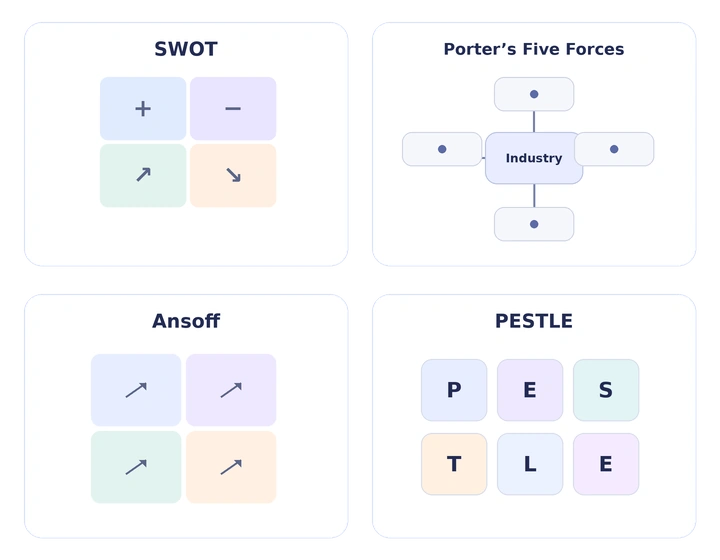
SWOT Analysis
SWOT analysis examines four aspects of an organisation:
- Strengths: Internal advantages and capabilities.
- Weaknesses: Internal limitations.
- Opportunities: External conditions that may support growth.
- Threats: External risks that could affect performance.
Students often use this framework to evaluate an organisation's position and identify possible strategic priorities.
PESTLE Analysis
PESTLE analysis examines six external business environment factors:
| Factor | Area of analysis |
|---|---|
| Political | Government policy, taxation and political stability |
| Economic | Inflation, interest rates and economic growth |
| Social | Demographics, culture and consumer behaviour |
| Technological | Innovation, automation and digital developments |
| Legal | Employment laws, regulations and compliance |
| Environmental | Sustainability and environmental responsibilities |
A good assessment explains how these factors affect the organisation rather than simply listing them.
Porter's Five Forces
Michael Porter's Five Forces framework examines competitive pressures within an industry.
Its five elements are:
- Competitive rivalry.
- Threat of new entrants.
- Bargaining power of suppliers.
- Bargaining power of buyers.
- Threat of substitute products or services.
Students can use this model to evaluate industry attractiveness and understand the sources of competitive pressure.
Ansoff Matrix
The Ansoff Matrix helps organisations consider four growth strategies:
- Market penetration.
- Market development.
- Product development.
- Diversification.
It is particularly useful when evaluating business expansion opportunities and associated risks.
McKinsey 7S Framework
The McKinsey 7S Framework examines seven interconnected organisational elements:
- Strategy.
- Structure.
- Systems.
- Shared values.
- Skills.
- Style.
- Staff.
Students can use this framework to investigate organisational alignment and understand challenges associated with change.
Balanced Scorecard
The Balanced Scorecard evaluates organisational performance across four perspectives: financial, customer, internal business processes, and learning and growth.
It helps students understand why financial performance alone may not provide a complete picture of organisational success.
Stakeholder Theory
Stakeholder Theory examines the interests and influence of individuals and groups affected by business activities.
Assignments may use it to evaluate corporate decisions, ethical responsibilities and conflicts between stakeholder expectations.
Leadership and Motivation Theories
Business management modules frequently explore theories that explain employee behaviour and leadership effectiveness.
Examples include:
- Maslow's Hierarchy of Needs.
- Herzberg's Two-Factor Theory.
- McGregor's Theory X and Theory Y.
- Transformational Leadership.
- Transactional Leadership.
- Situational Leadership.
Students should consider the context and limitations of each theory when applying it to organisational situations.
Change Management Models
Change management frameworks explain how organisations prepare for and implement change.
Common examples include Lewin's Three-Step Model and Kotter's Eight-Step Change Model. These approaches can help students evaluate organisational transformation, employee resistance and implementation challenges.
Marketing Mix and STP Framework
The marketing mix examines product, price, place and promotion, with the extended 7Ps adding people, process and physical evidence.
Segmentation, Targeting and Positioning (STP) helps explain how organisations identify customer groups and establish a suitable market position.
Our Approach to Business Assignment Academic Support
We follow a straightforward process to understand your requirements and identify the most suitable form of academic guidance.
Step 1: Share Your Assignment Brief
Provide your assessment question, module information, marking criteria and any relevant university instructions.
These details help establish the expected academic level, assignment format and areas that require attention.
Step 2: Discuss Your Academic Requirements
Explain the difficulties you are experiencing. You may need help understanding a management theory, developing a research plan, interpreting a case study or improving your draft.
Our team can discuss the relevant support options with you.
Step 3: Receive Subject-Specific Guidance
You receive guidance based on the requirements discussed. This may include explanations of relevant concepts, research suggestions, structural advice or feedback on your own work.
Step 4: Review Feedback and Improve Your Work
Use the guidance to strengthen your understanding and develop your own submission. Review the assessment brief and university requirements before submitting your work.
Need academic guidance?
Need a Clearer Direction for Your Business Assignment?
Business coursework can become challenging when you are unsure how to approach a question, select relevant theories or organise your research.
Share your assignment requirements with Easy Assignment Help. Our team can help you understand the task and discuss suitable academic support.
Discuss Your Business AssignmentShare your requirements and ask about available support.Why Choose Easy Assignment Help for Business Academic Support?
Choosing academic support is an important decision. You need to understand what a service offers, how it approaches your requirements and whether its support is suitable for your course.
Here are the areas we believe students should consider when seeking help.
Support Across Different Business Disciplines
Business courses cover several specialisations, from marketing and finance to strategic management and international business.
Subject-specific guidance helps students understand the terminology, theories and analytical approaches relevant to their modules.
Guidance Aligned with Your Assignment Brief
Every assessment has its own requirements. We consider the assignment question, learning outcomes and marking criteria when discussing suitable academic support.
This helps keep guidance relevant to the task rather than relying on generic explanations.
Understanding of UK Academic Expectations
UK universities commonly expect students to demonstrate critical thinking, independent research, appropriate referencing and evidence-based arguments.
Understanding these expectations can help you develop work that reflects the academic standards of your course.
Clear Feedback and Communication
Academic feedback should explain what needs improvement and why.
We aim to make guidance understandable, relevant and practical so you can identify areas of your work that need further attention.
Support with Academic Research and Referencing
Finding reliable evidence and using it correctly are important parts of business coursework.
We can help explain academic source evaluation, citation conventions, research approaches and reference list preparation.
Transparent Pricing and Service Information
Students should understand the scope and cost of a service before making a decision.
We encourage you to discuss your requirements and clarify what is included in the available support. Any applicable fees and service conditions should be explained before you proceed.
How to Approach a Business Assignment Successfully
A structured approach can make even a complex business assessment easier to manage. The following steps can help you organise your work and develop stronger academic arguments.
Understand the Assignment Question
Start by identifying the instruction words in your question.
For example:
- Analyse: Examine an issue in detail and explain its significance.
- Evaluate: Assess strengths, weaknesses and overall effectiveness.
- Compare: Identify similarities and differences.
- Discuss: Examine different perspectives and develop a reasoned argument.
- Critically assess: Evaluate evidence and consider limitations.
Pay attention to the assignment scope, word count and learning outcomes.
Identify the Relevant Business Concepts
Once you understand the question, identify the theories and concepts that relate to it.
For example, an assignment examining employee motivation may require relevant motivation theories, while a question about competitive strategy may involve industry analysis and competitive positioning.
Avoid including theories simply because they are familiar. Every concept should contribute to answering the question.
Find Reliable Academic and Industry Sources
Use appropriate sources to support your discussion. These may include peer-reviewed journal articles, academic textbooks, company reports, government publications and reputable industry research.
Consider the publication date, author credibility, research methods and relevance of each source.
Develop an Evidence-Based Argument
A strong academic argument connects a claim with supporting evidence and explanation.
Rather than presenting a series of facts, explain what the evidence demonstrates, how it relates to the question and whether alternative interpretations exist.
Apply Critical Analysis and Evaluation
Critical analysis involves examining the quality and limitations of information.
You should consider different viewpoints, identify weaknesses in existing arguments and explain the implications of your findings.
Where appropriate, use real-world examples to demonstrate how business concepts operate in practice.
Structure, Reference and Review Your Work
Check that your introduction establishes the purpose of the assignment, your main sections develop the discussion and your conclusion addresses the original question.
Review your citations, reference list, formatting, grammar and overall presentation before submission.
Business Assignment Examples and Academic Learning Resources
Examples can help students understand how academic concepts are explained and how different assessment formats are organised. However, they should be used as learning resources rather than copied into assessed submissions.
We recommend exploring the following resources:
Business Management Assignment Examples
Explore how management concepts can be applied to organisational situations. Focus on the relationship between theories, evidence and conclusions.
Business Case Study Examples
Study how a company or industry challenge can be investigated through relevant evidence, business frameworks and critical evaluation.
Business Report Structure Examples
Review the organisation of executive summaries, findings, discussions and recommendations to understand how business reports communicate information.
Business Assignment Referencing Examples
Use referencing examples to understand how to acknowledge academic books, journal articles, company reports and online publications.
Where sample material is published by Easy Assignment Help, it should be clearly labelled with its purpose, academic level and appropriate usage guidance.

Academic Integrity and Responsible Business Assignment Support
Academic integrity means producing and submitting work that honestly reflects your own knowledge, research and contribution. UK universities expect students to follow their institution's rules on authorship, collaboration, referencing and the use of external assistance.
We encourage students to understand these requirements before seeking help.
Understanding Your University's Academic Integrity Policy
Universities have individual policies covering plagiarism, collusion, contract cheating and the use of artificial intelligence.
Read your institution's guidance and check the rules for your specific assessment. If you are uncertain whether a particular form of assistance is permitted, ask your module tutor or academic support team.
Using Feedback and Model Examples Responsibly
Feedback and educational examples can help you understand academic expectations and identify areas for improvement.
Use them to learn about structure, argument development and referencing. Do not present another person's work as your own or submit material that your university prohibits.
Maintaining Your Own Academic Voice and Authorship
Your assessed work should represent your own understanding and independent contribution.
Tutoring, explanations, planning guidance and permitted proofreading can support your learning, but they should not replace your responsibility for researching, evaluating and producing your submission.
Frequently Asked Questions About Business Assignment Help
Can You Help Me with My Business Assignment in the UK?
Yes. Easy Assignment Help provides academic guidance for UK business students across different subjects and study levels. Depending on your requirements, support may include understanding assessment briefs, assignment planning, research guidance, business theory explanations, referencing and feedback on your own draft.
How Can I Get Help with My Business Assignment?
Start by sharing your assignment brief, subject, academic level and areas where you need support. Explain whether you are struggling with research, structuring, critical analysis or referencing. This helps establish the most appropriate academic guidance for your requirements.
What Topics Are Covered in Business Assignment Help?
Business assignments can cover management, marketing, finance, human resources, entrepreneurship, business economics, international business, strategic management, operations and organisational behaviour. The specific topics depend on your course and assessment brief.
Can I Get Business Assignment Help for Undergraduate and Postgraduate Studies?
Yes. Academic guidance can be adapted to different levels of study. Undergraduate assessments often focus on applying core concepts and developing analytical skills, while postgraduate work generally requires more advanced evaluation, independent research and theoretical understanding.
How Can I Structure a Business Assignment?
A typical business assignment includes an introduction, main discussion and conclusion, although reports and research projects may require additional sections. Start by analysing the assessment brief, organise your main arguments into logical headings, support your discussion with credible sources and use the referencing style specified by your university.
Can You Help Me Understand a Business Management Case Study?
Yes. Academic guidance can help you identify the main organisational issue, examine relevant stakeholders, select suitable management theories and interpret supporting evidence. You can then use these insights to develop your own evaluation and conclusions.
Can I Get Help with Business Research and Referencing?
Yes. Research guidance can cover academic database searches, source evaluation, research questions, qualitative and quantitative methods, citations and reference list formatting. The appropriate approach depends on your assessment requirements and university guidelines.
How Much Does Business Assignment Help Cost?
The cost depends on the type of academic support, complexity of the subject, level of study and amount of guidance required. Ask for a clear explanation of the available service and any applicable fees before making a decision.
Is Using Business Assignment Help Cheating?
Not automatically. Tutoring, explanations and feedback may be permitted under your university's academic integrity rules. However, paying someone to complete assessed work that you are expected to produce independently can constitute contract cheating. Always check your institution's policy before using an external service.
Can I Get Feedback on My Business Assignment Draft?
Yes. Feedback on your own draft can help you identify unclear arguments, weak evidence, structural problems and referencing errors. It can also help you understand whether your discussion addresses the assessment criteria.
How Quickly Can I Receive Business Assignment Feedback?
Response times depend on the type and scope of support requested, the availability of the relevant subject specialist and the amount of material requiring review. Share your deadline and requirements in advance so that availability can be discussed.
How Do I Choose a Reliable Business Assignment Help Service?
Look for clear service information, relevant subject knowledge, transparent pricing, genuine contact details and appropriate privacy policies. A responsible provider should explain its academic support boundaries and avoid guaranteeing grades or encouraging students to submit somebody else's work.
Get Business Assignment Guidance from Easy Assignment Help
Business coursework can challenge your understanding of management concepts, research methods, organisational decisions and academic writing. Having a clear approach to your assessment can make the learning process more manageable.
Easy Assignment Help aims to support UK business students through subject-focused explanations, assignment planning, research guidance and feedback on their own work.
Whether you are studying business management, marketing, finance or international business, you can discuss your academic requirements and explore suitable support options.
Ready to discuss your business assignment?
Let's Discuss Your Business Assignment
Contact Easy Assignment Help to explain your requirements and find out how we can support your academic learning.
Get clarity on your assessment requirements and the academic support available.
Contact Easy Assignment Help