
Corporate Finance Dissertation Topics for 2026
Many students preparing for a finance dissertation start their search on forums, Reddit threads and university discussion boards. Reading through those threads shows the same worries coming up again and again. Below are the questions students most often ask when they feel stuck.
- What is a strong corporate finance dissertation topic for 2026?
- How do I know if my topic is too broad or too narrow?
- Are ESG and sustainable finance still worth researching this year?
- What corporate finance thesis topics for undergraduate students actually get approved by supervisors?
- Do master’s and PhD topics need to be handled differently?
- Where can I find a full list of research topics in corporate finance before I meet my supervisor?
Picking a dissertation topic in corporate finance is one of the first big academic decisions a student makes, and it shapes almost everything that follows. A weak topic leads to a shaky literature review, unclear objectives and a methodology that never quite fits. A well-chosen topic, on the other hand, gives a student a clear direction from the first meeting with their supervisor.
Corporate finance itself sits at the centre of how companies raise money, invest it and manage risk. Because the field touches capital markets, governance, sustainability and technology all at once, students often feel there are too many directions to choose from. Some general guidance on structuring a proposal is available through dissertation proposal writing help, which can be a useful reference point while a topic is still taking shape.
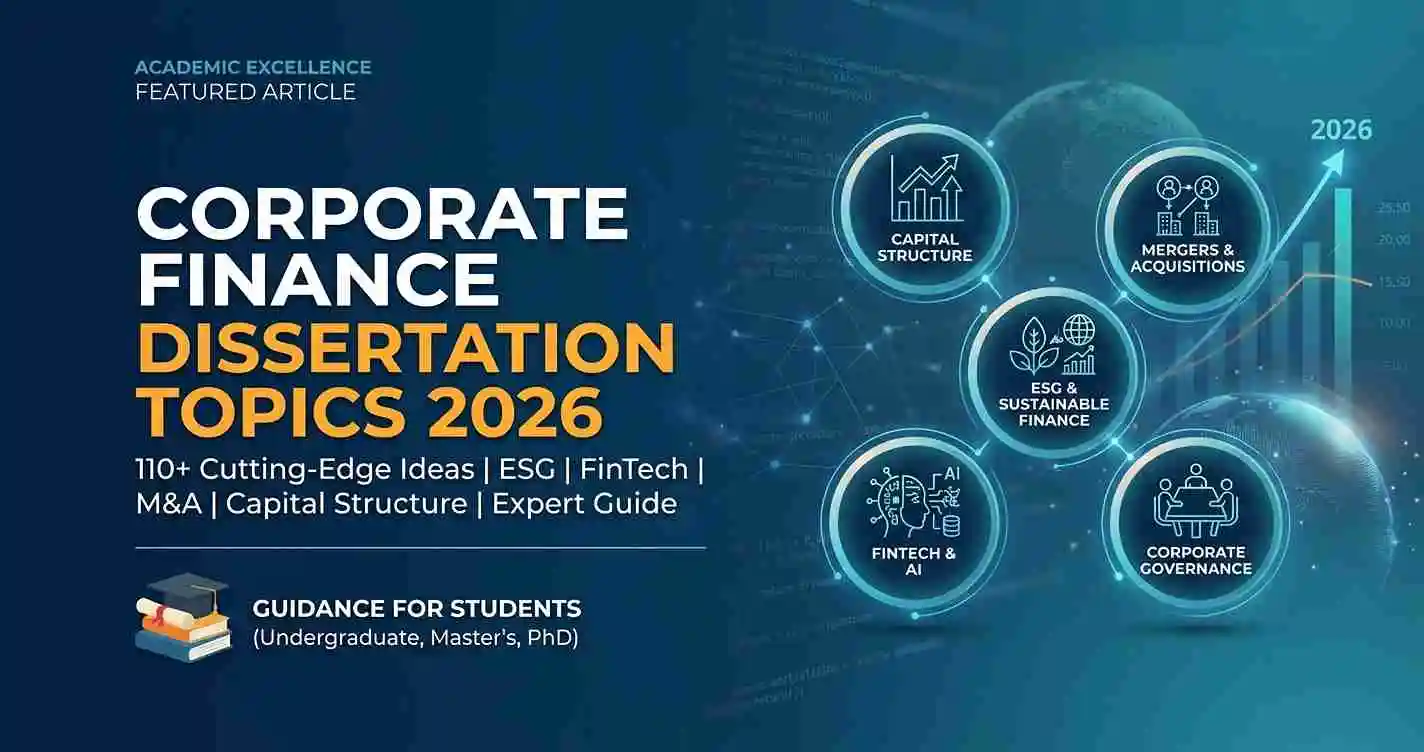
This post works through why topic selection matters, the main research areas inside corporate finance, five worked examples with aims and objectives, and then a list of more than one hundred original topics grouped by subject area and academic level.
Why Choosing the Right Corporate Finance Dissertation Topic Matters
A dissertation topic is not just a title on a cover page. It sets the boundaries of the literature a student needs to read, the data they need to collect and the arguments they can realistically make within a word limit.
If a topic is too wide, such as “corporate finance in the modern economy,” a student ends up trying to summarise an entire discipline instead of answering one focused research question. If it is too narrow, there may not be enough published literature or data to support proper analysis. The right topic sits between these two extremes.
Topic choice also affects how examiners judge originality. A dissertation that repeats a well-worn question from ten years ago, without a new angle, context or dataset, rarely stands out. Choosing a topic connected to a live debate in the field, such as green bond pricing or AI-driven credit risk models, gives a student something genuinely current to contribute to.
Finally, the topic needs to match the academic level. A PhD topic should point towards a genuine gap in theory or method. A master’s topic should demonstrate strong applied analysis. An undergraduate topic should show a clear understanding of established finance theory applied to a specific case or context.
Key Research Areas in Corporate Finance to Explore
Corporate finance covers how firms make decisions about funding, investment and value creation. Before narrowing down to a single topic, it helps to understand the broad research areas the field is currently organised around.
Capital structure and financing decisions looks at how firms choose between debt and equity, and how that choice affects firm value, risk and cost of capital.
Mergers, acquisitions and corporate restructuring examines why firms combine, how deals are financed, and what happens to performance, leverage and shareholder value afterwards.
Corporate governance studies how boards, ownership structures and executive incentives shape financial decisions and firm outcomes.
ESG and sustainable finance has grown into one of the largest areas of research topics in corporate finance, covering green bonds, climate risk disclosure, sustainability-linked lending and the financial effects of environmental and social performance.
Fintech and digital transformation looks at how automation, artificial intelligence, blockchain and digital platforms are changing corporate treasury management, credit assessment and financial reporting.
Risk management and financial distress covers how firms identify, measure and manage financial risk, including bankruptcy prediction and credit risk modelling.
Dividend policy and payout decisions asks why firms choose to pay dividends, buy back shares, or retain earnings, and how markets react to these choices.
Behavioural corporate finance applies psychology to financial decision-making, looking at manager overconfidence, herding behaviour and biased forecasting.
Each of these areas offers dozens of possible angles, which is exactly why the topic list further down this page is organised under these same subfields.
Five Corporate Finance Dissertation Topics With Research Aims and Objectives
The following examples show how a strong topic is built. Each one includes a clear aim and a small set of measurable objectives, which is the structure most UK universities expect in a proposal.
1. The Impact of ESG Disclosure Quality on the Cost of Capital in Listed UK Firms
Aim: To examine whether higher-quality ESG disclosure is associated with a lower cost of capital among UK-listed companies.
Objectives:
- To review existing literature linking ESG disclosure and firm financing costs.
- To measure ESG disclosure quality using a recognised scoring framework.
- To test the statistical relationship between disclosure scores and cost of capital across a sample of UK firms.
2. Capital Structure Decisions in Small and Medium Enterprises After Interest Rate Changes
Aim: To investigate how UK SMEs adjust their capital structure in response to changes in interest rates.
Objectives:
- To identify the main financing sources used by SMEs before and after rate changes.
- To analyse leverage ratios across a sample of SMEs over a defined period.
- To assess whether SME capital structure decisions follow trade-off theory or pecking order theory.
3. The Role of Board Gender Diversity in Corporate Risk-Taking Behaviour
Aim: To explore whether gender diversity on corporate boards influences the level of financial risk firms are willing to take.
Objectives:
- To review governance theory relating to board composition and risk appetite.
- To measure board diversity and risk indicators across a sample of publicly listed firms.
- To evaluate whether diversity levels correlate with measures such as leverage and earnings volatility.
4. Artificial Intelligence Adoption and Credit Risk Assessment in Corporate Lending
Aim: To assess how the adoption of AI-based credit scoring models affects the accuracy of corporate credit risk assessment.
Objectives:
- To compare traditional credit scoring methods with AI-driven models.
- To evaluate the predictive accuracy of both approaches using historical lending data.
- To discuss the practical and ethical implications of AI adoption in corporate lending decisions.
5. Dividend Policy Choices Among Family-Owned Versus Non-Family Firms
Aim: To compare dividend payout behaviour between family-owned and non-family-owned firms.
Objectives:
- To review theoretical explanations for dividend policy differences based on ownership structure.
- To collect dividend payout data across matched samples of family and non-family firms.
- To identify whether ownership concentration significantly predicts payout ratios.
These examples show that the best corporate finance dissertation topics are specific, measurable and tied to an identifiable gap in existing research, rather than broad statements about the industry.
110 Corporate Finance Dissertation Topics for 2026
The list below is organised by subfield and academic level, so it works whether a student is completing an undergraduate project, a master’s dissertation or a PhD research proposal. Each topic is written to be researchable within a standard dissertation timeline.
Capital Structure and Financing Decisions
- Determinants of capital structure choices among UK manufacturing firms
- The effect of tax policy changes on corporate debt levels
- Trade-off theory versus pecking order theory in emerging market firms
- Capital structure adjustment speed following economic shocks
- The influence of credit rating changes on corporate borrowing costs
- Debt maturity structure and firm investment decisions
- The role of collateral availability in corporate financing choices
- Capital structure differences between family firms and institutional-owned firms
- The impact of interest rate volatility on long-term corporate debt issuance
- Financing decisions of high-growth technology firms compared with mature industrial firms
Mergers, Acquisitions and Corporate Restructuring
- Post-merger financial performance in cross-border acquisitions
- The role of due diligence quality in merger success rates
- Payment method choice in mergers and its effect on shareholder returns
- Cultural distance and integration challenges in international M&A deals
- Private equity buyouts and long-term firm performance outcomes
- The effect of regulatory scrutiny on merger completion rates
- Corporate divestitures as a strategy for value creation
- Leverage changes following large-scale acquisitions
- Shareholder wealth effects of hostile versus friendly takeovers
- Deal financing structures in technology sector acquisitions
Corporate Governance and Board Effectiveness
- Board independence and its relationship with financial reporting quality
- Executive compensation structures and long-term firm performance
- The influence of institutional ownership on corporate decision-making
- Board gender diversity and dividend policy outcomes
- CEO duality and its effect on firm risk levels
- Audit committee characteristics and earnings management practices
- The relationship between ownership concentration and agency costs
- Governance structures in state-owned versus privately owned firms
- Whistleblowing mechanisms and corporate financial misconduct
- Board tenure and strategic financial decision-making
ESG, Sustainability and Green Corporate Finance
- Green bond issuance and its effect on firm valuation
- Corporate carbon disclosure and access to bank credit
- Sustainability-linked loans and covenant design
- Greenwashing risk in corporate ESG reporting
- Climate transition risk and corporate capital allocation
- ESG ratings divergence across rating agencies and its market impact
- The financial performance of firms with net-zero commitments
- Investor reaction to environmental controversies in listed firms
- ESG integration in corporate treasury and cash management
- Supply chain sustainability disclosure and firm cost of capital
Fintech, AI and Digital Transformation in Corporate Finance
- Blockchain adoption in corporate treasury operations
- Artificial intelligence in corporate financial forecasting accuracy
- Digital lending platforms and SME access to finance
- Robotic process automation in corporate financial reporting
- Cryptocurrency holdings on corporate balance sheets
- Central bank digital currencies and corporate cash management strategies
- Machine learning models for corporate bankruptcy prediction
- Cybersecurity risk disclosure and firm valuation
- Open banking regulation and corporate financial data sharing
- Algorithmic trading impact on corporate share price volatility
Risk Management and Financial Distress
- Early warning indicators of corporate financial distress
- Hedging strategies and firm value in commodity-dependent industries
- Liquidity risk management practices in post-pandemic supply chains
- The effect of geopolitical risk on corporate investment decisions
- Currency risk exposure and hedging behaviour among exporting firms
- Corporate insurance purchasing decisions and risk retention strategies
- Financial distress prediction using non-financial disclosure data
- Stress testing practices in non-financial corporations
- Interest rate risk management in highly leveraged firms
- The role of enterprise risk management frameworks in firm resilience
Dividend Policy and Corporate Payout Decisions
- Dividend smoothing behaviour among UK listed companies
- Share buybacks versus dividends as shareholder value strategies
- Life-cycle theory and dividend payout patterns
- Tax reform effects on corporate dividend decisions
- Dividend policy signalling and market reaction studies
- Payout policy differences between growth and value firms
- The influence of free cash flow levels on payout decisions
- Dividend policy in regulated versus unregulated industries
- Institutional investor pressure and corporate payout ratios
- Dividend policy consistency during periods of earnings volatility
Behavioural Corporate Finance
- CEO overconfidence and corporate investment decisions
- Herding behaviour among corporate financial managers
- Behavioural biases in capital budgeting decisions
- Managerial optimism and merger and acquisition activity
- The influence of framing effects on corporate risk disclosure
- Anchoring bias in corporate valuation practices
- Loss aversion and corporate debt repayment behaviour
- Behavioural explanations for underinvestment in profitable projects
- Social influence and boardroom decision-making dynamics
- Emotional decision-making during corporate financial crises
Corporate Finance Thesis Topics for Undergraduate Students
- Working capital management and profitability in retail firms
- The relationship between firm size and access to bank finance
- Cash flow management practices in small manufacturing businesses
- The impact of inventory management efficiency on liquidity
- Short-term financing choices among UK small businesses
- Financial ratio analysis as a predictor of firm performance
- The effect of trade credit policies on supplier relationships
- Break-even analysis in decision-making for new product launches
- Budgeting practices and financial control in growing firms
- The role of working capital cycles in seasonal businesses
Research Proposal Ideas for a PhD in Corporate Finance
- A dynamic model of capital structure adjustment under regulatory uncertainty
- The interaction between ESG risk and systemic financial risk
- Long-term effects of algorithmic decision-making on corporate governance structures
- A cross-country analysis of climate policy and corporate capital allocation
- The evolution of agency theory in the context of AI-managed corporate treasuries
- Network effects in cross-border merger financing decisions
- A theoretical framework linking behavioural biases to systemic corporate risk
- The long-run valuation effects of central bank digital currency adoption on firms
- Institutional quality as a moderator of capital structure theory across regions
- A comparative theory-building study of governance failure in high-growth firms
Project Topics in Corporate Finance for Masters Students in the UK
- The impact of Bank of England interest rate decisions on UK corporate borrowing
- Private equity investment trends in the UK middle market
- Corporate financing strategies of UK renewable energy firms
- The effect of Brexit-related trade policy on UK multinational financing decisions
- ESG regulation in the UK and its influence on listed company disclosure
- Access to finance challenges for UK SMEs in the post-pandemic period
- Capital allocation strategies among UK FTSE 250 companies
- The role of UK development banks in supporting corporate investment
- Corporate tax policy changes and their effect on UK business investment
- Cross-border financing strategies of UK firms expanding into Europe
Whatever level of study a student is at, the aim is the same: pick a topic narrow enough to research properly, but connected to a live issue in the field. Anyone still narrowing down a direction can find further structural guidance through help with dissertation planning before committing to a final title.
Conclusion
Choosing a corporate finance dissertation topic in 2026 means balancing personal interest, current research relevance and academic level expectations. The subfields covered in this guide, from capital structure and governance to ESG, fintech and behavioural finance, represent where the discipline is actively moving, not just where it has been.
A strong topic gives a clear research aim, measurable objectives and a realistic path to data and literature. It should also say something specific, rather than repeating a question the literature has already answered many times over. The examples and the full topic list in this guide are meant as a starting point for that thinking, not a replacement for the conversations a student will have with their own supervisor.
Whichever topic is chosen, treating the dissertation as a genuine piece of original research, rather than a box to tick, tends to produce the strongest academic work and the most rewarding experience along the way.
